Lesson 18 of 20 · 14 moves
Dürer’s Heptagon
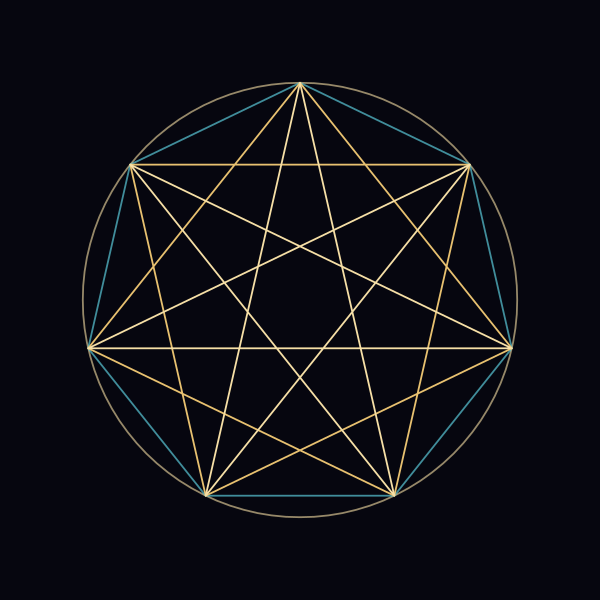
Step Dürer’s near-heptagon around the circle from P.
No compass can draw a true heptagon: Gauss found which polygons can be constructed, and Wantzel proved in 1837 that seven is not among them. Painters and masons needed one all the same.
Albrecht Dürer’s handbook of 1525 gives the old workshop rule: half the side of the triangle in a circle is almost exactly the side of its heptagon. Step it around the rim from both sides of P.
The app snaps to every crossing, checks your construction exactly, and offers hints one move at a time.
Step by step
Compass carries a length to a new centre. Euclid showed in his second proposition that a collapsing compass can always do the same.
Circle centred on P through O: it cuts the rim twice.
Join the two cuts: the side of the triangle in the circle. It halves OP at M.
Compass: take half of it, from M to its end, and set it down on P. Two corners.
Circle centred on the corner to the left, through P: the next corner.
And on the corner to the right, through P.
Step once more on the left.
And once more on the right: seven corners.
Join the corners: sides 1 to 6.
The last side closes the figure, a hair too long.
What it shows
Each stepped side is 0.8660 of the radius, where a true heptagon’s is 0.8678: short by one part in five hundred, so the last side comes out a little long. Close enough for any mason, never for Gauss.