Forms of the Plane · 3D
Clelia Curve
The rose wound onto a sphere
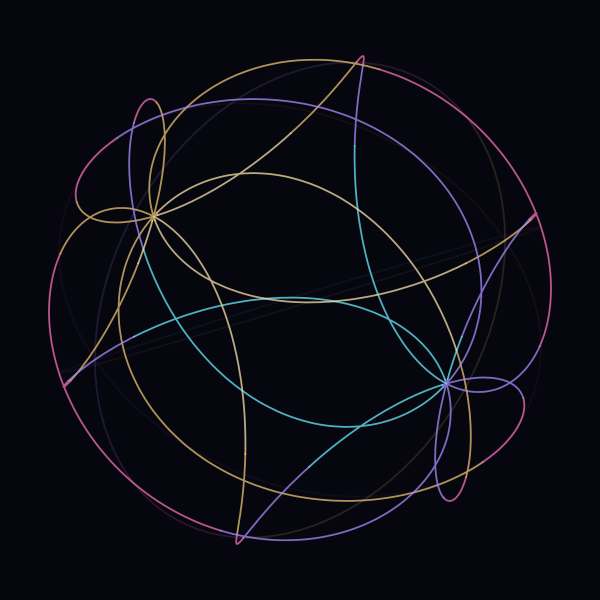
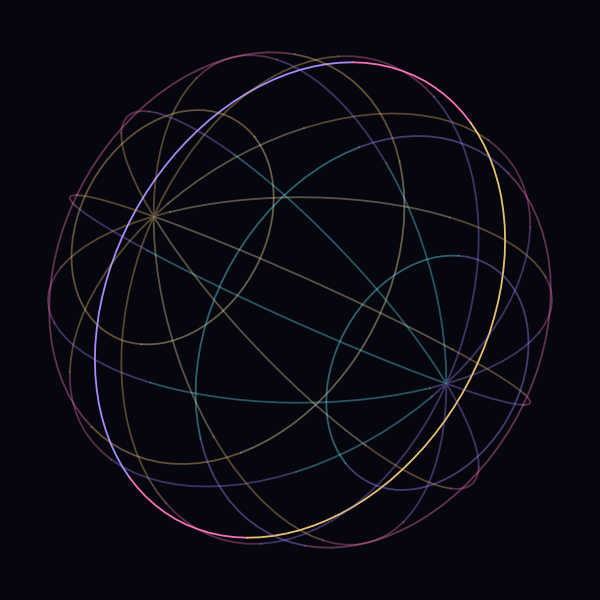
Travel a sphere so that your latitude turns k times as fast as your longitude and you trace a Clelia curve. Seen from above, every Clelia is a rose: its radius from the axis is exactly cos(k·θ).
- Latitude
- k · longitude
- k
- n / d
Turn it in your hands, strike it to hear the chord of its edges, slice it with a plane.
Facts
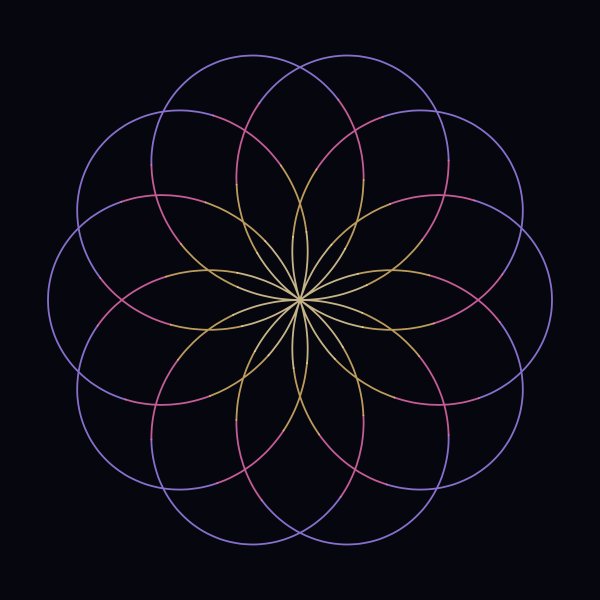
- Looking straight down, the curve is the flat rose r = cos(kθ), every petal traced once above the equator and once below.
- With k = 1 it is Viviani’s curve, where a sphere meets a cylinder half its width. Its shadow is the one-petalled rose, a circle.
- Each petal of the rose is the shadow of a loop running from the pole down to the equator and back.
History and meaning
Guido Grandi, who named the rose after the Greek for rose-like, also found these curves on the sphere in 1728 and named them for Countess Clelia Borromeo, a mathematician of Milan.
Across the dimensions
- Its shadow Rhodonea RoseLet the rose’s radius be a circle of latitude: the curve winds over a sphere, and its shadow is the rose.